


Fragments of a History: Cassinese Manuscripts between Reuse and Reassembly
In Cluj, Chiara De Angelis and Marilena Maniaci presented new research on the Compactiones and the material transformations of Montecassino manuscripts.
Manuscripts preserve more than the texts written on their pages. Dismemberment, reuse, reassembly and restoration have left material traces that make it possible to reconstruct the histories these books underwent over the centuries. This perspective was at the heart of the paper presented by Chiara De Angelis and Marilena Maniaci at the international conference Medieval Books in the Early Modern Period, held in Cluj and Alba Iulia from 8 to 11 September 2026.
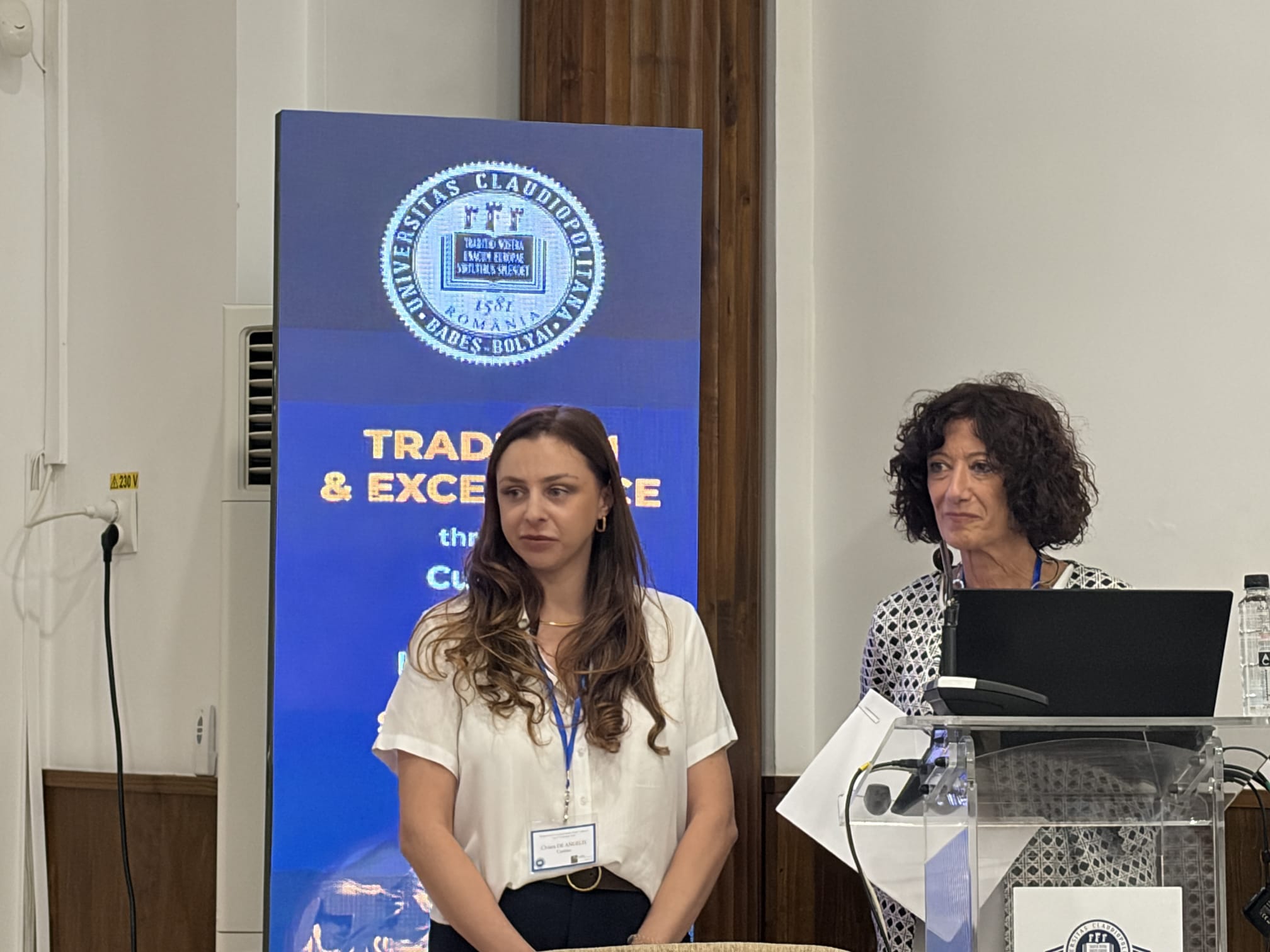
Organised by the CODEX Centre at Babeș-Bolyai University, the conference explored the survival and transformation of medieval books during the early modern period, bringing together research on the preservation, dismemberment and reuse of manuscripts and fragments in different European contexts. Within this framework, the paper Cassinese Manuscripts Between Dismemberment and Recomposition: The Genesis of the Compactiones, and the Late Seventeenth-Century Restoration Campaign focused on Montecassino’s manuscript heritage and the material transformations that accompanied its transmission.
The paper presented some of the results of Chiara De Angelis’s doctoral research, beginning with an analysis of the ways in which fragments written in Beneventan script were reused and of their distribution over time. Particular attention was devoted to the so-called Compactiones, collections of fragments preserved at Montecassino. Their study has made it possible to reconstruct seven manuscripts that now survive only in fragmentary form and to compare these materials with codices preserved intact in the Cassinese library.
The analysis also provided new evidence for the history of the formation of the Compactiones. Far from being the result of a single intervention, the collection appears to have developed progressively over time: chronological evidence found on some of the fragments suggests that its earliest phases can be traced back at least to the late fourteenth century. This reconstruction also makes it possible to reconsider its relationship with the extensive campaign to renew manuscript bindings carried out at Montecassino in the late seventeenth century under Abbot Biancardi. An examination of 38 manuscripts with bindings dating from this campaign has shown that the reuse of manuscript fragments was not a systematic practice, helping to distinguish the gradual formation of the Compactiones from the late seventeenth-century campaign.
The study of fragments thus reveals a history that does not necessarily coincide with that of manuscripts preserved intact. Dates, traces of reuse, bindings and reassemblies document practices that succeeded one another over time and make it possible to reconstruct, through the materiality of the books themselves, particular moments in the history of the library and in the preservation of Montecassino’s manuscript heritage.