


The Research Unit of the University of Catania is composed of Simona Inserra, who coordinated the work, together with Francesca Aiello, Corrado Di Mauro, Debora Di Pietro, Marco Lugnan, Marco Palma and Laura Rogari. During the three years of the project, the group of scholars worked on the survey and description of the incunabula preserved at Montecassino and collaborated in the digitisation process through the selection of materials and the creation of metadata. The group worked with the ISTC (Incunabula Short Title Catalogue), through the Incunabula Office of the National Central Library of Rome, to add or correct data in the international database; it completed the cataloguing of the incunabula in OPAC SBN and described copies and provenances in MEI (Material Evidence in Incunabula).
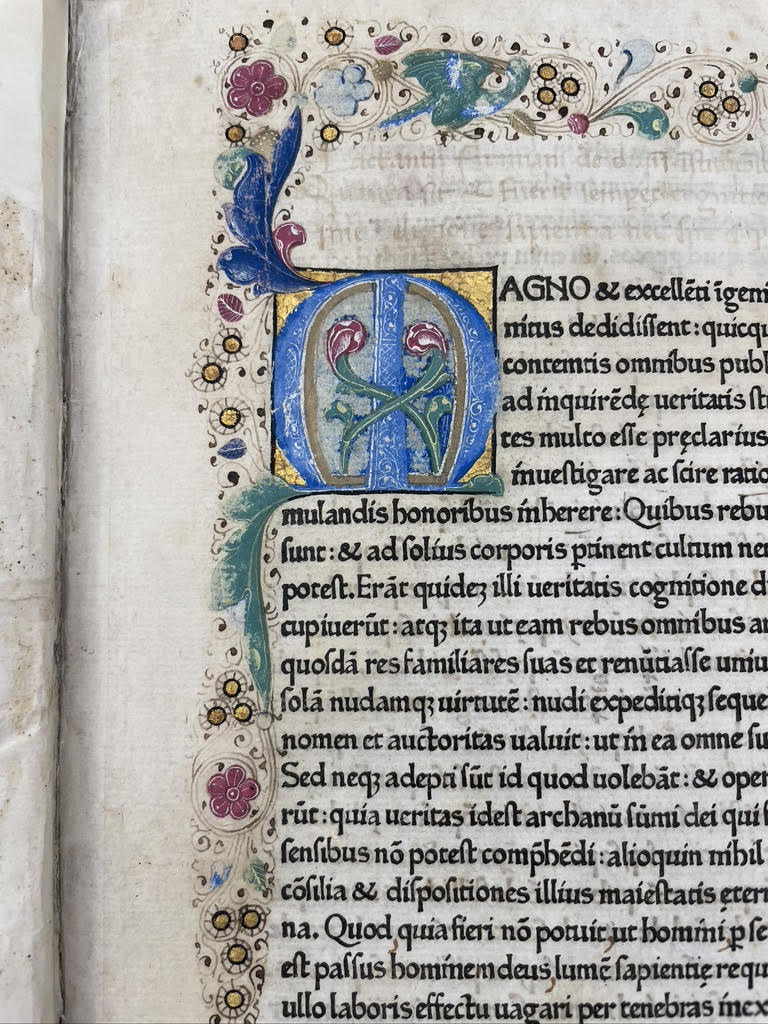
The first phase of the survey led to the identification of a number of missing items and of several incunabula that had not been identified either during the 1929 cataloguing campaign—which resulted in the publication, edited by Itala Santinelli Fraschetti and Camillo Scaccia Scarafoni, of the Catalogo degli incunabuli di Montecassino, published by the Abbey of Montecassino—or in the subsequent period. On the occasion of the preparation of the 1929 Catalogue, the two incunabulists identified and briefly described 252 editions, divided between the Biblioteca Monumentale, which held 189 of them, and the Biblioteca Privata, which held 63. The group belonging to the Monumental Library included the copies from the original Cassinese collection, later incorporated into the Biblioteca pubblica statale attached to the Monumento nazionale di Montecassino, identified at that time and described in entries 1–189 of the Catalogue. The editions were listed alphabetically by author; for each one, edition data and references to the principal bibliographical repertories were provided, while information concerning the individual copy included details of the binding, together with additional notes on possible inclusion in composite volumes. The original Cassinese collection included copies of editions printed between 1459 (Guillaume Durand, Rationale divinorum officiorum, printed at Mainz by Johann Fust and Peter Schoeffer) and 1500, as well as, of particular importance, the 1465 Lactantius.
Compared with the incunabula listed in the 1929 catalogue, the following items are now missing: no. 39 (a copy of the editio princeps of Aristotle’s Organon in Greek, printed in Venice by Aldus Manutius between 1495 and 1498), stolen by De Caro and his associates, as emerges from the report filed with the Carabinieri and from further documentation consulted regarding this and the other copies listed below; no. 40 (a copy of the Articella, printed in Padua by Nicolas Petri around 1476); no. 108 (a copy of Gratian’s Decretum, printed in Venice by Nicolas Jenson in 1474); no. 130 (a copy of Regiomontanus’ Epitoma in Almagestum Ptolomaei, De rerum natura of Lucretius printed in Venice by Aldus Manutius in 1500); no. 163 (a copy of Regiomontanus’ Epitoma in Almagestum Ptolomaei printed in Venice in 1496 by Johann Hamman), stolen by De Caro and his associates; no. 164 (a copy of Regiomontanus’ Kalendarium printed in Augsburg by Erhard Ratdolt in 1489), also stolen by De Caro and his associates; a number of woodcuts removed from the copy of Hartmann Schedel’s Liber chronicarum , described under no. 171, likewise stolen by De Caro and his associates; abd no. 183 (a copu of Jouan Torquemada’s Tractatus de efficacia aquae benedictae , listed in the catalogue as “S.n.t. [15th century?]”.
To the copies described in the 1929 catalogue must be added a number of copies identified during our survey activities and not recorded in ISTC, which will be described in detail in the catalogue Incunaboli a Montecassino (Viella, forthcoming).
As for the Biblioteca privata, it originally contained 63 editions. A note placed in the preface to the Catalogo made clear the open nature of the collection: «the small collection is continually increasing». Indeed, today, almost a century later, we record the presence of 75 editions in 79 physical volumes. This collection was created by the monks following the suppression of ecclesiastical property and the confiscation of the Abbey’s collections, thanks above all to donations and several acquisition campaigns. According to the 1929 catalogue, the earliest edition is represented by a copy containing texts on the Vita et transitus of Saint Jerome by various authors (Pseudo-Sebastian of Cassino, Pseudo-Eusebius of Cremona, Pseudo-Augustine, Pseudo-Cyril and other anonymous texts, all dedicated to Saint Jerome), printed in Venice by Bartolomeo da Cremona in 1473. Chronologically, this is followed by a copy of Lucan’s Pharsalia with the extensive commentary of Ognibene Bonisoli, printed in Venice in 1475.
Compared with the incunabula listed in the 1929 catalogue, the following are now missing: no. 9 (198), a copy of the Regula of Saint Benedict, printed in Venice by Bernardino Benali in 1489; no. 25 (214), a copy of Dante’s Commedia with the commentary of Cristoforo Landino, printed in Venice by Pietro di Quarengi in 1497; no. 27 (216), a copy of Marsilio Ficino’s De vita libri tres, printed in Florence in 1489 by Antonio di Bartolommeo Miscomini; no. 31 (220), a copy of Gregory the Great’s Dialogorum liber secundus de vita et miraculis sancti Benedicti, printed in Venice by Bernardino Benali in 1490; no. 39 (228), a copy of the De imitatione Christi, also printed in Venice by Francesco de Madiis in 1486; no. 41 (230), another copy of the De imitatione Christi, printed in Venice by Bernardino Benali in 1488; and no. 62 (251), a copy of Valerius Maximus’ Facta et dicta memorabilia, printed in Venice in 1478 by the printers identified by the initials P.F., B.R., S.F., and Z.F.
At the present stage of research, we are not able to determine whether De Caro and his associates also intervened in this section of the collection, except in the case of a copy of the 1497 edition of the Commedia with Cristoforo Landino’s commentary, printed in Venice by Pietro Quarengi. As of today, taking into account the regrettable thefts and considering both the identification of fifteenth-century editions within composite volumes containing sixteenth-century texts and further acquisitions by the monastic library “Paolo Diacono”, the total number of physical objects—and consequently, according to our descriptive model, the number of catalogue entries included in Incunaboli a Montecassino — amounts to 254: 175 belonging to the State Library and 79 to the Monastic Library.
Overall, the collections contain a total of 265 fifteenth-century editions: 188 in the State Library and 77 in the Monastic Library (including two cases of doubtful attribution to the fifteenth century, described in an appendix to the catalogue). With the exception of six items displayed in the showcases of the Abbey Museum, all incunabula are housed in the historical collection of the Library, separated between the shelves of the State Library and those of the Monastic Library.
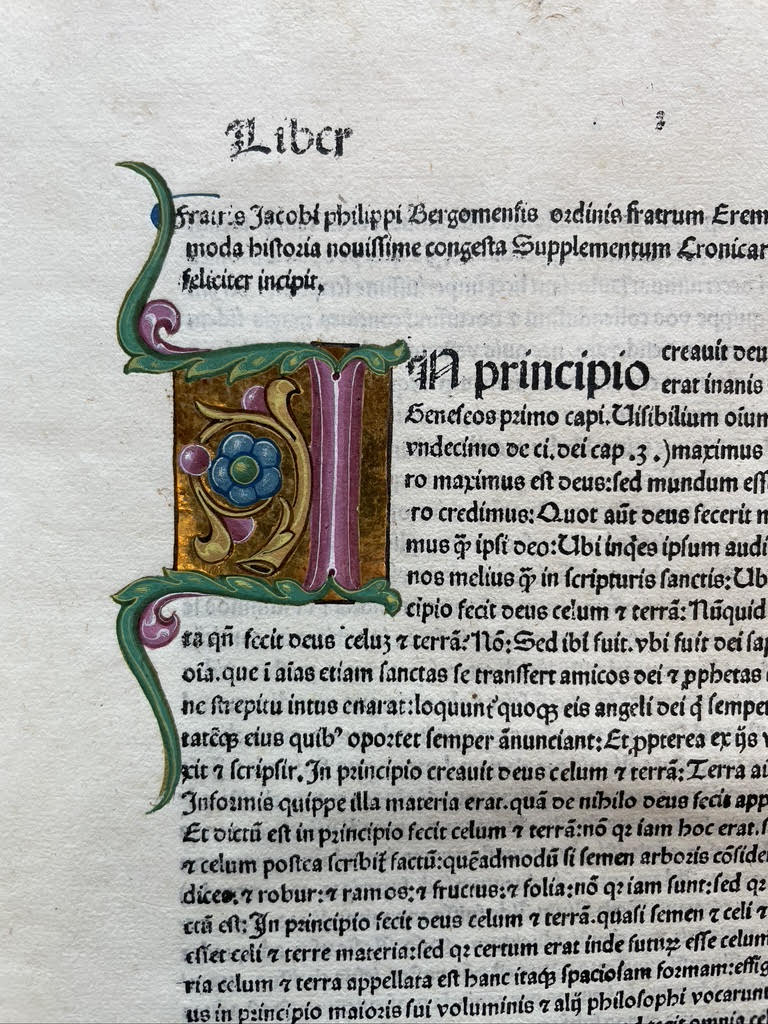
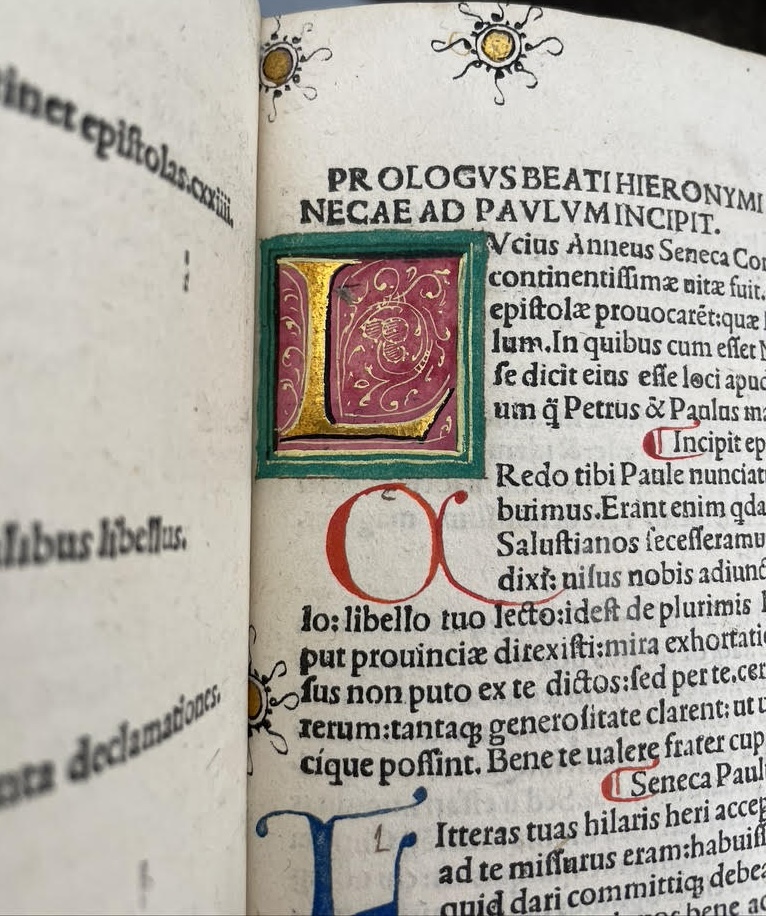
The descriptive activities and the parallel research devoted to identifying the provenances of individual copies have made it possible to uncover the names of owners—institutions as well as individuals—who possessed these incunabula over the centuries. Intensive research within the Abbey’s archival documentation relating to the sixteenth through nineteenth centuries has provided a number of interesting data, complementing what was already known concerning purchases, donations and exchanges carried out during those centuries.
As regards digitisation activities, at this stage of the project they have concerned only the incunabula belonging to the State Library.
The possibility of digitising these materials and including the images of each volume, together with the essential accompanying information, within MeMo’s integrated digital system, provides our incunabula with a level of visibility they have never previously enjoyed. It also contributes an important component to the project for the digitisation of incunabula preserved in monastic libraries in Italy, launched in 2018 under the scientific direction and organisational coordination of the National Central Library of Rome, in collaboration with CERL (Consortium of European Research Libraries) and with financial support from the Polonsky Foundation. In 2020, this initiative led to the creation of the BM Biblioteche Monastiche portal BM Biblioteche Monastiche, where the 206 incunabula preserved in the Library of the Monastery of Saint Scholastica at Subiaco have already been described and digitised.
The research carried out at the Incunabula Office of the National Central Library of Rome, together with the consultation of archival documentation relating to exchanges between the IGI (Indice Generale degli Incunaboli delle biblioteche d’Italia) and the Library of Montecassino, has made it possible to acquire a series of important elements concerning the history of Montecassino’s incunabula and their cataloguing treatment, as well as the restoration work undertaken on some copies.
The most significant result achieved by our Research Unit is the publication, in 2025, of the catalogue Incunaboli a Montecassino, issued by the publisher Viella in the series Incunaboli, directed by Marco Palma. The catalogue, preceded by a Storia della biblioteca written by Dom Mariano Dell’Omo, has been prepared according to a model developed and tested over the last decade, consisting in the application to fifteenth-century printed books of the methodology originally devised for manuscript cataloguing. These descriptions are based on a detailed examination of individual copies and, in a sense, reverse the perspective traditionally adopted in incunabula cataloguing. The focus is shifted from the edition to the individual copy, considered as the bearer of elements which, once described and studied, can also offer a deeper understanding of the processes involved in the typographical manufacture of a fifteenth-century book, starting from the model of the manuscript copy.
Careful attention to the material evidence preserved in each copy—reading notes, ex libris, ex dono inscriptions, stamps and ownership notes, illuminations, disruptions in the sequence of gatherings, damage, alterations, restorations, binding features and state of preservation—makes it possible to bring to light elements that are essential for a fuller understanding of the history of each physical object. This methodology has led to the identification of a very large number of provenance traces, making it possible to reconstruct, at least in part, the journeys undertaken by each incunabulum through time and space, from the moment of its printing to its arrival at Montecassino.
Among the results of greatest significance for the international scholarly community are the enrichment of incunabula records in OPAC SBN, the updating of information contained in the Incunabula Short Title Catalogue through the reporting of inaccurate or incomplete data and the addition of new bibliographical information, and the recording of owners in MEI (Material Evidence in Incunabula), including the creation of the corresponding authority records and the documentation of the material evidence observed in individual copies.
Part of the results achieved during the three-year research project were presented publicly on 27 and 28 February 2025 during the international conference In balia del tempo e dello spazio: libri in movimento nella prima età moderna, held at the Department of Humanities of the University of Catania.