


Benedictine Landscapes in Dialogue: Networks Across Time
From 25 to 28 November 2025, the conference “I paesaggi benedettini. Territorio, patrimonio culturale e spiritualità ”, promoted by DTC Lazio and hosted in key sites of the Benedictine tradition – including Subiaco, Montecassino, and other centres – brought together scholars, monks, cultural institutions, and universities to reflect on a theme of enduring relevance: the Benedictine capacity to create networks.
These networks are not merely geographical. They are cultural, spiritual, and intellectual networks, shaped by the circulation of people, knowledge, texts, architectural models, and territorial practices.
This perspective emerged clearly across the sessions, which highlighted how monasteries – both historically and today – act as vital nodes within a complex system shaped by evolving political, social, and territorial dynamics.
Among the themes that stood out during the conference was the role of initiatives such as MeMo – Memory of Montecassino and MeMo–ViAM, which today represent a concrete continuation of the Benedictine tradition of interconnectedness.
Through advanced digital tools, interoperable platforms, and international collaborations, MeMo is reconstructing and making accessible a true “graphic and manuscript landscape” that resonates with the issues addressed throughout the event: the memory of places, the materiality of manuscripts, the journeys of texts, and the communities that produced and transmitted them.
The participation of the University of Cassino, a long-standing partner of Montecassino and a key centre for research on medieval book culture, underscored the academic world’s role in building lasting bridges with monastic communities.
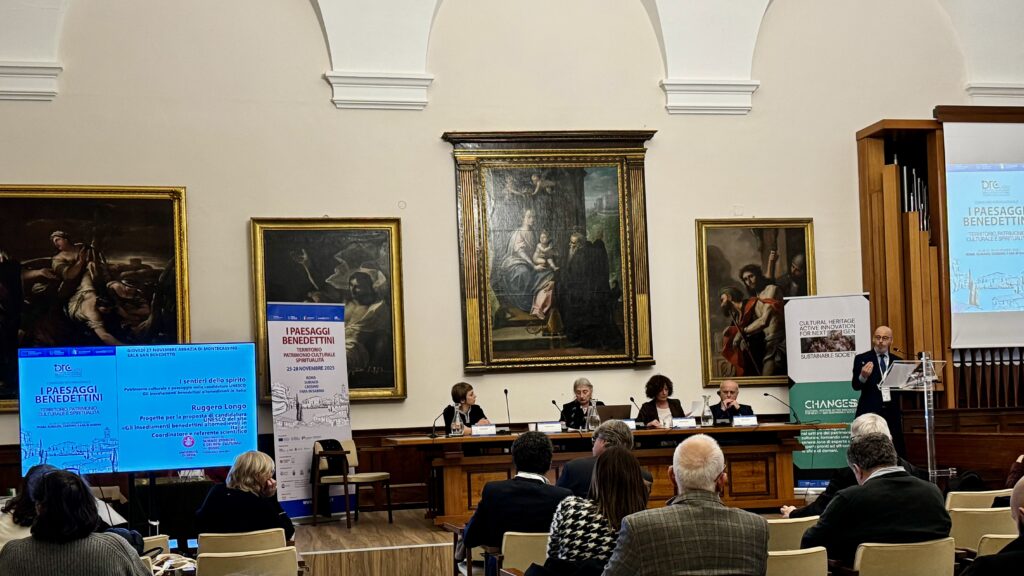
This is a dynamic relationship, grounded in reciprocal exchange and shared projects: from the digitisation and cataloguing of the Cassinese library collections to the new developments of MeMo – ViAM, which is pioneering immersive experiences dedicated to the arts and crafts of the book.
The conference demonstrated that these worlds – monastic and academic – are not distant realms but complementary dimensions of a single story: that of a memory that continues to be generated, interpreted, and transmitted.
Thanks to the synergies promoted by DTC Lazio, this memory can now be read as a vibrant, multilayered network that connects the past with the possibilities of contemporary research.
A network that MeMo and MeMo – ViAM continue to expand and make accessible, one link at a time.