


Humanities between tradition and innovation
The MeMo project within the debate on digital transformation
Within the framework of recent initiatives devoted to the relationship between humanities and digital technologies, the conference Studi umanistici: approccio classico, multidisciplinare e tecnologico, held at the Accademia Pontaniana in Naples on 5th-6th May 2026, provided a significant opportunity for dialogue among diverse yet converging perspectives.
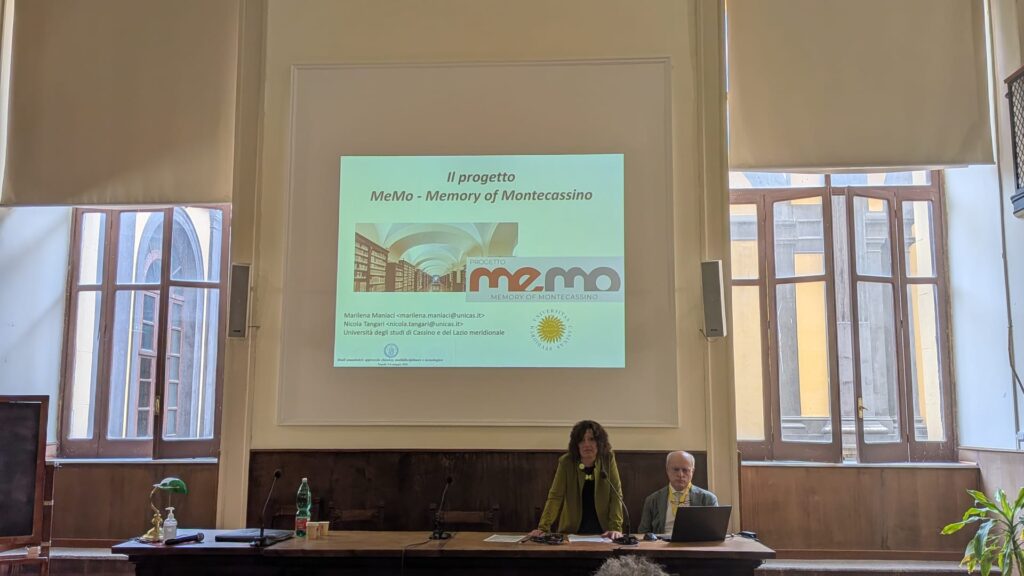
In this context, the presentation by Marilena Maniaci and Nicola Tangari, dedicated to the project MeMo – Memory of Montecassino, formed part of a broader reflection on the ongoing transformation of studies on the early book – both manuscript and printed – and on documentary heritage. Positioned alongside contributions addressing artificial intelligence, automated transcription, and digital tools for humanities research, the talk highlighted how MeMo represents a concrete example of integration between traditional approaches and innovative methodologies.
The project is grounded in a systematic activity of study, description, and cataloguing of the materials preserved at the Abbey of Montecassino, while at the same time developing digital tools that expand possibilities for access, analysis, and dissemination. In this sense, the technological dimension does not constitute a secondary element, but rather an integral part of the research process.
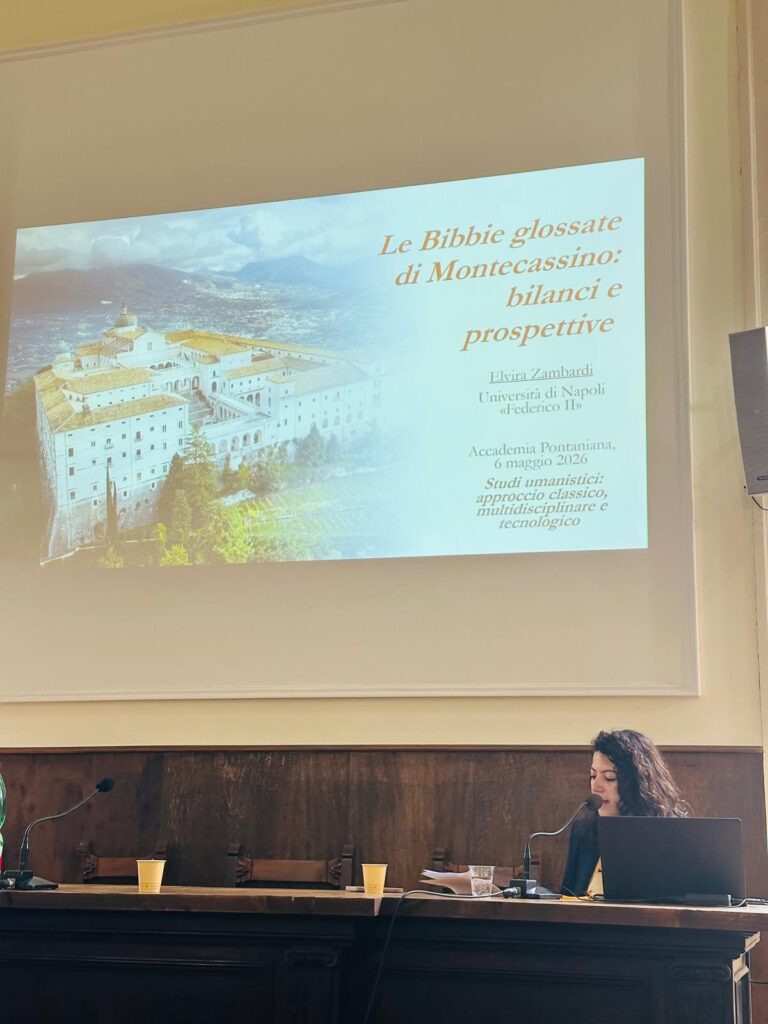
Particular importance is given to the dialogue with other experiences and areas of expertise, as demonstrated by collaborations established also in scientific and technological contexts, including that with the MAGIC project. This was the focus of the presentation by Elvira Zambardi, currently a research fellow, together with Giuseppina Civitillo and Ylenia Nardone, within the project carried out by the Department of Physics at the University of Naples “Federico II”. The experience presented, which combines a humanities background with the practical stages of digitisation, thus functions as a trait d’union between the two projects, MAGIC and MeMo, within a collaborative and synergic framework aimed at achieving more informed results. Such interactions contribute to defining a common ground in which different disciplines converge towards shared objectives: the preservation, understanding, and transmission of written heritage.
MeMo’s presence within a context such as the Naples conference therefore confirms the role the project is assuming in the field of humanities, not only as an initiative of cataloguing and digitisation, but as a laboratory in which new forms of integration between skills, tools, and methods are explored.
Digitisation thus emerges, once again, not as an endpoint, but as an opening towards new possibilities for investigation and connection.
The full programme is available below.